

Creating sustainable and efficient induction training
An online approach saved the Schwarzman Centre time and money on training hundreds of staff and students quickly
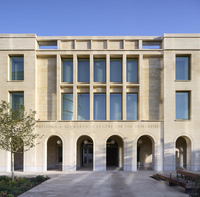
After months of anticipation about Oxford University’s new Centre for the Humanities, the Schwarzman Centre opened its doors in October 2025. The building had received global acclaim and attention for its ultra-energy-efficient design standards and the sustainable nature of its architecture, but it wasn’t just in the construction phase where the team at the Schwarzman looked to prioritise these principles.
The induction challenge: removing barriers and saving time
When the new building opened, the staff faced a major challenge: inducting thousands of students and hundreds of staff quickly without disrupting daily operations.
Traditionally, inductions are conducted in person; however, this approach often presents significant logistical challenges and can delay the commencement of work or study.
For a facility the size of the Schwarzman Centre, in-person inductions would have required 3 hours per session, with group sizes limited to no more than 20 participants. Managing this would have taken a lot of time and staff. The University’s Instructional Design team in IT Services responded with an online induction solution for both staff and students.
In close collaboration with the In-Use and Operations teams in Humanities, who created workflows and tested operability, representatives from the Estates team and the Instructional Design team held regular meetings to organise, review information, and establish content priorities. The Researcher Development and Training team in Humanities created workflows, tested operability, and hosted the module on the CoSy training management service. Colleagues were working to a stringent timeframe, as both staff and students were prohibited from entering the building prior to completing the induction course.
The result: efficiencies and savings
Separate inductions for staff and students were created, each designed to be completed in less than 30 minutes. These were uploaded to the University's CoSy training system, which allowed administrators to track completion and ensure attendees had finished the course before their first visit. Offering the course online enabled users to complete it in advance from the location of their choice.

Completion data, which is monitored by the Researcher Development and Training team in Humanities, shows that at the time of writing, 675 staff and 2,535 students had completed the induction training. Had these sessions been conducted face-to-face, 161 separate sessions would have been required.
By adopting online modules, staff at the Schwarzman Centre were able to reallocate 484 hours (more than 20 days) that would otherwise have been dedicated to in-person inductions.
Planning for the future
If you are planning inductions for your workplace, consider whether an online format might help.
To find out more about creating online induction modules or other training for your area please contact the Instructional Design team in IT Services.

